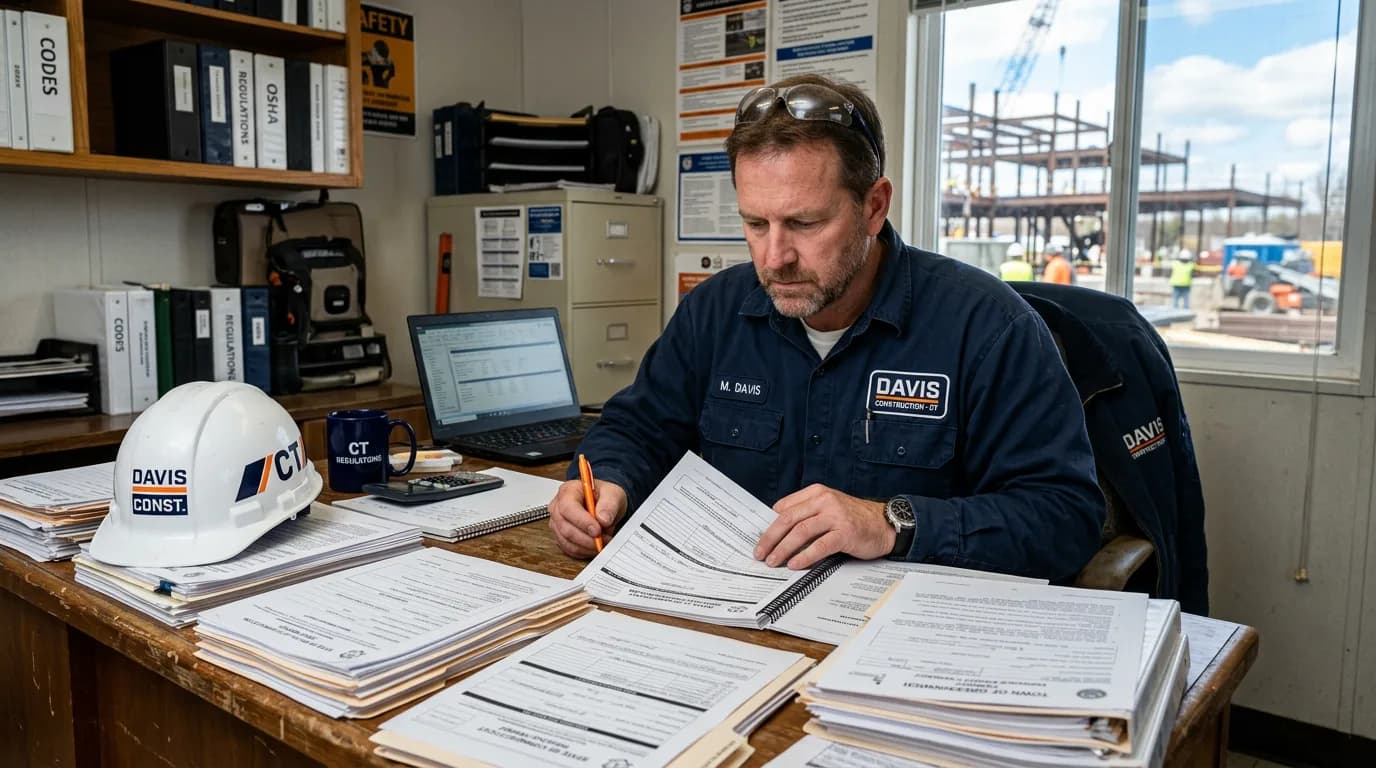
Connecticut's Department of Consumer Protection handles several thousand contractor complaints every year. A significant portion of those complaints — and the fines, license suspensions, and civil disputes that follow — trace back not to shoddy workmanship, but to paperwork problems.
Missing contracts. Permits that were never closed. Insurance that lapsed mid-project. Cancellation notices that weren't provided. These are the mistakes that create legal exposure for otherwise competent CT contractors.
Here are the five that come up most often, what they actually cost, and how to close the gap.
Mistake 1: Starting Work Without a Compliant Written Contract
The CT requirement: Any Home Improvement Contractor working on projects over $200 must provide a written contract before work begins. The contract must include the contractor's name, address, HIC registration number, project start and completion dates, total price, and payment schedule.
The contract must also include a Notice of Cancellation Rights — giving the homeowner 3 business days to cancel work solicited at their home.
What goes wrong: Contractors skip the written contract on "quick jobs" or work for repeat clients they trust. The $200 threshold applies to the contract value, not the estimated scope.
What it costs: A valid complaint to the DCP for a missing or non-compliant contract can result in a $500 civil penalty per violation. More expensive: a contract dispute with no written agreement becomes a he-said-she-said situation where the contractor typically loses. Unpaid invoices, forced rework, and legal fees add up fast.
The fix: Never start work without a signed, compliant contract. Period. If you're working for a repeat client and the job is truly small, a one-page document with the required fields is still a document.
Mistake 2: Letting Licensing and Insurance Lapse Between Jobs
The CT requirement: HIC registration renews every 2 years. Specialty trade licenses (electrical, plumbing, HVAC) have their own renewal cycles. General liability insurance must be maintained continuously — not just active when you're actively bidding work.
What goes wrong: Auto-renewal lapse during slow periods. A contractor thinks they're covered because they renewed last year. They're not.
What it costs: Working while unlicensed in CT carries civil penalties up to $500 per day, per violation — plus potential criminal exposure if the project is over a certain value. An insurance lapse during an active project is a personal liability exposure. If something goes wrong and you're not insured, you're paying out of pocket.
The fix: Set calendar reminders 90 days before every renewal date. Keep copies of current certificates in a dedicated job folder and in your truck. If a client, GC, or municipality ever asks, you should have it in 30 seconds.
Mistake 3: Pulling Permits Late or Not At All
The CT requirement: Permits must be applied for before work begins — not during, not after. This applies to structural work, electrical, plumbing, HVAC, and significant renovations. The permit card must be posted visibly on the job site.
What goes wrong: Contractors pull permits late to keep a project moving, assume the municipality won't notice, or skip permits entirely on work that "should" require one.
What it costs: Unpermitted work discovered during an inspection or by a future buyer's home inspector can require complete demolition and rebuild — at your expense, years after the job is done. Stop-work orders carry fines and delay costs. And a DCP complaint about unpermitted work can trigger a license review.
The fix: Build permit application into your pre-construction checklist. Know the processing timelines by municipality — they vary significantly across CT — and factor permit lead time into your project schedule. Waiting on a permit from Westport is different from waiting on one from Meriden.
Mistake 4: Missing Environmental Documentation
The CT requirements that get overlooked:
- Lead paint RRP (Renovation, Repair, and Painting): Any work in pre-1978 homes requires lead paint notification to the owner before work begins. If your crew disturbs more than 6 square feet of painted surface, EPA RRP certification is required. CT follows EPA requirements plus state-specific disposal rules.
- Asbestos survey: Demolition of structures built before 1980 in CT requires an asbestos survey before work begins. Not optional.
- DEEP stormwater permit: Projects disturbing more than 1 acre of soil require a DEEP general permit for stormwater discharge.
What goes wrong: Contractors assume environmental requirements only apply to large commercial projects. They apply to residential renovation work too.
What it costs: DEEP violations carry civil penalties up to $25,000 per day, per violation. EPA RRP violations run up to $37,500 per violation per day. These are not typos. Environmental compliance failures are in a different cost category than DCP paperwork violations.
The fix: Before any renovation or demolition project in CT, run through the environmental checklist: Is the structure pre-1978? Pre-1980? What's the square footage of disturbed surface? Is there soil disturbance over 1 acre? Match the project specs to the requirements.
Mistake 5: Incomplete Job Closeout Documentation
The CT requirement: It's less a specific regulation and more a business protection reality. When a job is done, you need: final inspection sign-off or Certificate of Occupancy, signed lien waivers from all subcontractors and suppliers, a written client acknowledgment of completion, warranty documentation, and records retained for a minimum of 3 years.
What goes wrong: Contractors collect their final check and move on before the paperwork is finished. Lien waivers don't get signed. Permits don't get closed. The "done" job becomes a problem 18 months later.
What it costs: An unclosed permit shows up when the homeowner tries to sell. An unsigned lien waiver means a subcontractor can file a mechanic's lien against the property — even if you paid them. A client who disputes the scope of work 2 years later and you have no signed completion acknowledgment is a client you're probably settling with.
The fix: Create a closeout checklist and don't invoice the final payment until it's complete. The final check is your leverage to get everything signed. Use it.
The Pattern Across All Five Mistakes
These mistakes have one thing in common: they all happen when compliance documentation is treated as something to handle after the work is done, rather than as part of the work.
The contractors who don't get DCP complaints, don't face permit issues, and don't find themselves in civil disputes are the ones who've built documentation into their workflow — not as extra work, but as part of how each project runs.
TechEd Analyst generates CT-specific compliance checklists and documentation for contractors — covering contract requirements, permit workflows, environmental documentation, and job closeout — so you're not starting from scratch on every project.